What Is the Evil Eye (Nazar)? Meaning, History, and Its Place in Turkish Culture
Walk through any Turkish home and you will notice it immediately: a deep cobalt-blue disc hanging by the front door, catching the light, watching over whoever enters. That object is a nazar amulet, and it has been protecting homes, newborns, and new beginnings for thousands of years. Step into a Turkish maternity ward and you will see one pinned to every newborn's blanket. Open a Turkish business on its first day and someone will almost certainly arrive with a nazar amulet as a gift.
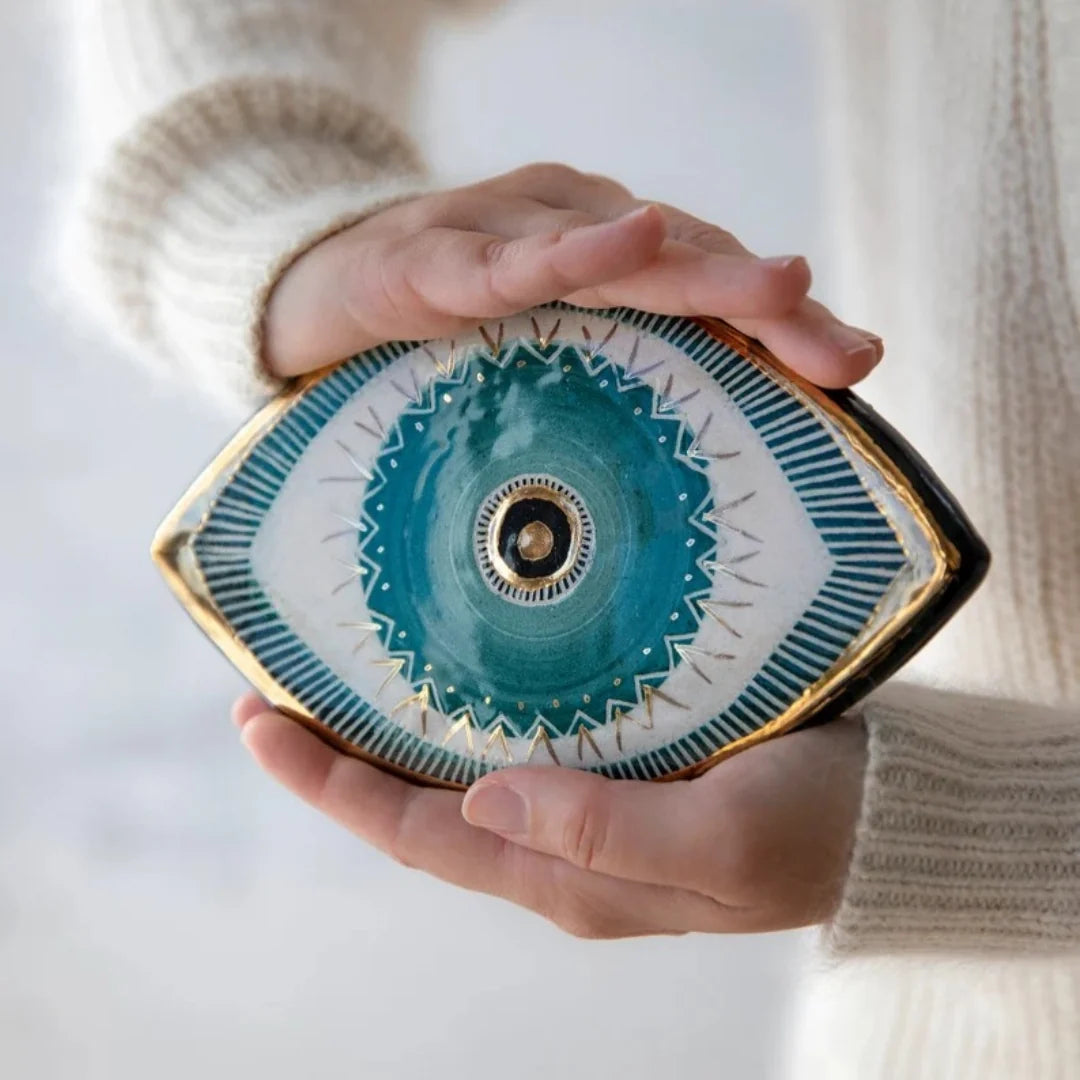
The nazarlık — a nazar amulet known across cultures as a protective eye symbol — is one of the world's most enduring good-luck traditions, woven into daily life across Türkiye, Greece, and the Middle East, and now, increasingly, into homes right here in North Texas. At House of Motifs in Historic Downtown McKinney, we carry a curated collection of handmade ceramic nazarlıks made by local women artists in Türkiye — each one a small piece of centuries-old tradition, shaped entirely by hand.
What Is Nazar? The Belief Behind the Amulet
"Nazar" (pronounced nah-ZAR) is a Turkish word of Arabic origin, rooted in the idea of vision, sight, and gaze. In its most common usage, nazar refers to the harmful energy that can be transmitted through an envious or overly admiring look — an idea often translated into English as "the evil eye," though in Turkish culture it carries none of the sinister connotations that phrase can suggest in Western contexts.
The core belief is this: when someone looks at you, your home, your child, or your success with intense admiration or envy — even unconsciously — that gaze can carry a negative energy capable of causing misfortune. It is not necessarily about malicious intent. In Turkish belief, even a well-meaning compliment delivered with too much intensity can invite nazar.
You may recognize the concept by other names: mal de ojo in Spanish-speaking cultures, malocchio in Italian, ayin hara in Hebrew, baskania in Greek. This belief spans more than 40 cultures across six continents and dates back over 5,000 years, making it one of the most widespread folk traditions in human history. The ancient Sumerians, Egyptians, Greeks, and Romans all developed amulets to ward it off, with eye-shaped protective talismans found as early as 3,000 BCE in Mesopotamia.
The Nazarlık: Turkey's Original Nazar Amulet
If nazar is the concern, the nazarlık is the answer. The nazar amulet is designed to absorb and deflect unwanted attention before it can reach its target. The logic is visual and intuitive: the eye design "catches" the envious gaze and turns it back on itself before it can cause harm.
Traditional nazarlıks are made from glass and recognized by their concentric-circle design: an outer ring of deep cobalt blue, a lighter blue or white ring, then a dark pupil at the center. This palette is not arbitrary — in Turkish folk belief, blue is a protective color, associated with the sky, water, and divine guardianship. The most traditional glass nazarlıks are made in the village of Görece, near İzmir, using lampworking: melting glass rods over an open flame and shaping them by hand. When a nazarlık cracks or breaks, it is considered a good omen — the amulet has done its job, absorbing a blow meant for its owner, and should be replaced rather than mourned.
Nazar in Turkish Culture: From Birth to Business
What makes nazar so fascinating is how deeply it is woven into the entire arc of Turkish life, from the first moments of existence to the founding of a new enterprise.
When a Baby Is Born
In Türkiye, one of the first gifts given to a newborn is a nazarlık, typically pinned to the baby's clothing — usually on the left shoulder, closest to the heart — or hung above the crib. The vulnerability of newborns makes them especially susceptible to concentrated attention and admiration. In Turkish hospitals it is common for midwives and nurses to attach a small nazarlık to the baby's blanket even before the family can. The belief runs deep: the more beautiful and beloved, the more protection is needed.
When a Child Starts School
Many Turkish children wear a small nazarlık pinned to their uniforms or tucked into their bags on the first day of school, and often all year. Parents believe the admiration of teachers and peers, however loving, can unintentionally draw negative energy toward a child in a new environment.
When Someone Moves Into a New Home
Moving into a new home is a milestone that calls for both celebration and protection. Among the most meaningful housewarming gifts a guest can bring is a nazarlık, often a larger, more decorative version meant to hang near the entrance. The front door is considered the home's most vulnerable point, where external energies first make contact with the household. Turkish custom often pairs it with bread (so the household never goes hungry), salt (for health), and a small broom (to sweep away bad fortune) — but the nazarlık is the one that stays.
When a Business Opens
Opening a business is an act of ambition, and ambition attracts attention. In Turkish business culture, hanging a nazarlık above the door on opening day is considered essential, not merely decorative. The charm is meant to protect the enterprise from competitors' envy and the weight of others' expectations, catching a rival's passing glance and dispersing it harmlessly.
The Nazar Eye as a Modern Design Icon
In recent decades the nazarlık has grown beyond its folkloric origins into one of the most recognizable symbols of Turkish identity worldwide, and a powerful design icon in its own right. You will find the nazar eye on high-fashion runways, in celebrity jewelry, and in the interiors of luxury hotels around the world. Its visual power — that direct, unblinking gaze in cobalt and white — translates effortlessly across cultures.
For many people outside Türkiye, the nazarlık has become a beautiful object first and a cultural tradition second, and that is perfectly consistent with its long history: the amulet has always been as much about aesthetics as protection. That same eye appears throughout our own textiles too — from the crochet evil eye cushions to the Nazar silk velvet pillow cover — and across the wider language of Turkish motifs and their meanings.
Meet the Artisans Behind the Collection
The nazarlık ceramics we carry are not mass-produced, and they are not imported by the container. Each one is shaped by hand in a small studio in Türkiye by local women artists whose stories are as meaningful as the objects they make.
Many of them left fast-paced city careers for the slower rhythms of the Aegean coast, choosing to make objects that feel genuinely handmade — not in the marketing sense, but in the visceral, imperfect, human sense. Working in traditional Turkish ceramic techniques, they shape each nazarlık individually. Every piece is:
- 100% handmade — no molds, no machines, no shortcuts
- Completely original — no two pieces are identical
- Inspired by the Aegean — its colors, textures, and forms live in every curve
- Made with traditional techniques — honoring the lineage of Turkish ceramic art
The result is a nazarlık that feels alive. The glaze pools differently in each bowl of the eye, the edges are never perfectly smooth, and the blue shifts from piece to piece. These are not flaws — they are the signature of a human hand.
The Evil Eye Collection at House of Motifs
Ceramic Wall Hangings
The centerpiece of the collection: large, sculptural eye forms designed to hang on a wall as a protective talisman and a statement piece at once. They work above a front door (the traditional placement), in an entryway, as a focal point in a living room or bedroom, or in an office. Available from a minimalist medium size up to a bold statement size, each finished by hand with 24k gold luster detail.
Hamsa Designs
Among the most beloved pieces are the Hamsa, the open-hand symbol that predates Islam and appears across Jewish, Christian, and Islamic iconography as a universal sign of protection. In ceramic form the Hamsa becomes a sculpture of remarkable delicacy, rendered in the same cobalt-and-white palette as the classic nazarlık.
Handmade Evil Eye Coffee Cups
For an everyday piece of the tradition, our handmade evil eye coffee cups bring the nazar to the table — each one thrown and painted by hand by a local woman artist in Türkiye, so no two are exactly alike.
The Perfect Gift for Every New Beginning
If you are looking for a meaningful gift in McKinney — for a housewarming, a new baby, a business opening, or a graduation — consider what the nazarlık represents: the wish that someone's good fortune will be protected from the forces that would diminish it. It is, at its core, a gift of love expressed in the language of ancient belief. The most resonant gifts are the ones that carry a story, and the nazarlık has thousands of years of story to tell.
A Note on Meaning
You do not have to share in the tradition of nazar to appreciate the nazarlık. You do not have to be Turkish, or Greek, or from any of the cultures where this custom began. The symbol works on several levels at once: as a meaningful cultural artifact for the curious, as a gesture of goodwill for those who give it, and as an extraordinary object of design for those who simply respond to beauty. What the nazarlık asks of you is attention — the same quality it is designed to redirect.
Visit House of Motifs
Our evil eye ceramics, textiles, and coffee cups are available in our boutique in Historic Downtown McKinney and online at houseofmotifs.com.
House of Motifs
119 W Virginia Street, McKinney, TX 75069
Store Hours
Tuesday–Friday: 10:00 AM – 5:00 PM
Saturday: 10:00 AM – 6:00 PM
Sunday: 12:00 PM – 5:00 PM


